


|
|
|
|
|
|
|
|
|
 |
||||
|
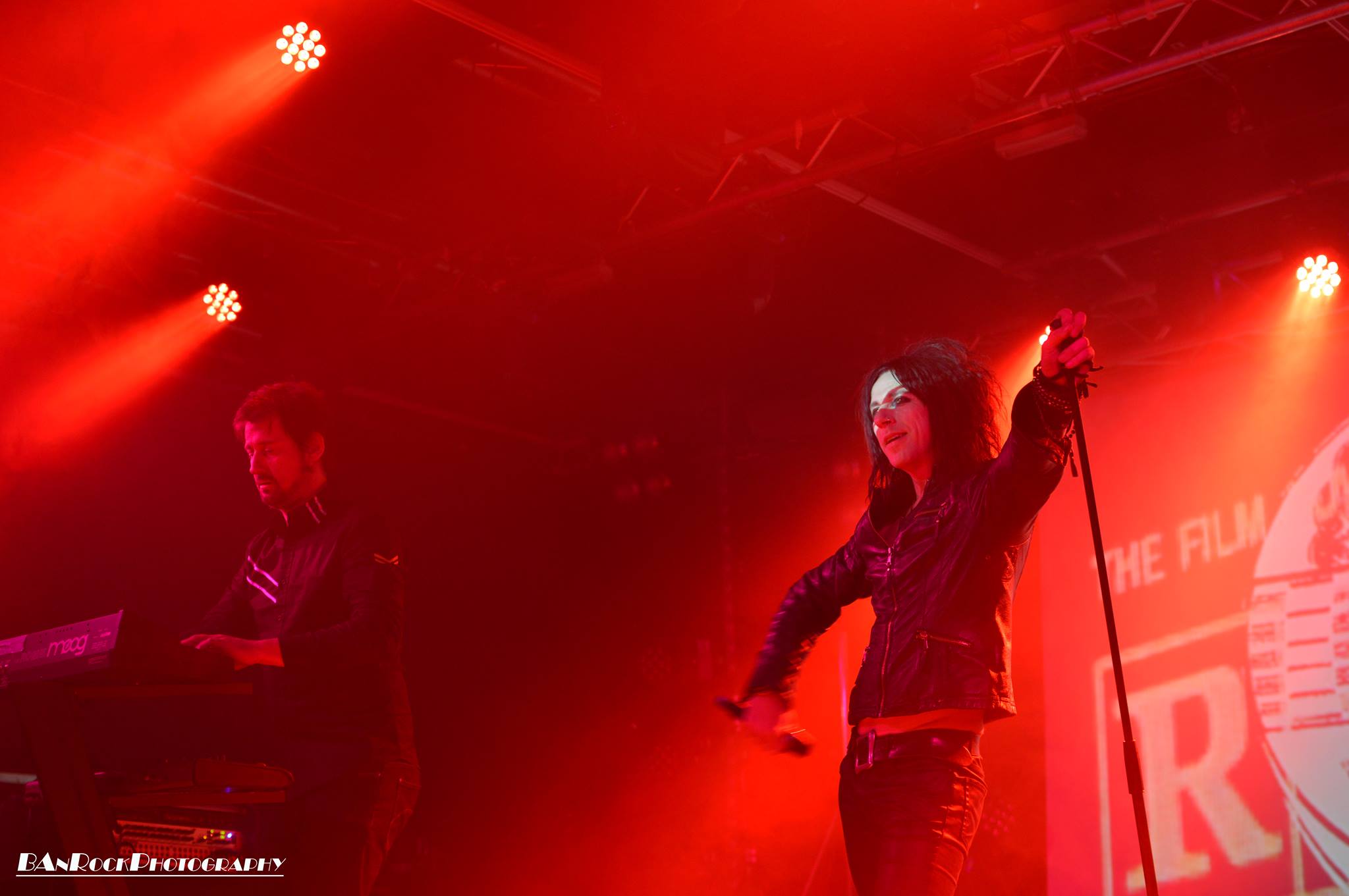
Live at INFEST 2015 - photo by DJ Bon |
|||
Coming from an ex-knocking shop located somewhere in the heart of London, Mechanical Cabaret is centered around the music, lyrics and voice of Roi Robertson, currently together with multi-instrumentalist and producer Stephen J. Bellamy, and Tobie Chandler for live shows. Founded in 1999 after the suicides of his first bands Dekolette Erotika (1990-1995) and Nekromantik (1995-1998), Roi and his Mechanical Cabaret combine edgy, sometimes atmospheric, often downright filthy synthesizer experiments with a plethora of sampled found-sound, off-kilter melodies and a spiky electronic pulse. With a post-industrial synth-punk energy, coupled with Roi’s deadpan baritone and sardonic lyrics, it's all delivered with a healthy dose of typically British dark humour. Roi and his travelling Mechanical Cabaret have been provoking audiences around Europe for 20 years, where he really comes into his own as a dynamic, energetic frontman. They've played many headline shows and club gigs, and supported the likes of such musical luminaries as Fad Gadget, Karl Bartos of Kraftwerk, Nitzer Ebb, Suicide, DAF, Front 242, The Damned, Sigue Sigue Sputnik, Frontline Assembly, Sheep On Drugs, A Flock Of Seagulls, T’Pau, Client, T.Raumschmiere, Mesh, Covenant, Alien Sex Fiend, Clan Of Xymox, Apoptygma Berserk and VNV Nation. Mechanical Cabaret release their music digitally and physically on their own labels Soiled Records and Zos Kia Records via Bandcamp. They have had their music released by several record labels along the way, including Wax Trax!2/WTII, Major, Alfa Matrix, Disco Minge, Dependent, Resurrection, and Mute. Copyright: Mechanical Cabaret/SOILED Records 2023 |
||||
Mechanical Cabaret Biography... 1990 - 1999Roi's been recording and performing music since 1990 when, still in his teens, he was writing and performing songs which would eventually end up being released under the name Mechanical Cabaret, when he chose the name in early 1999. His first band started in 1990, and was based in Wales where he spent said teens and part of his early twenties, going by the name Dekolette Erotika. This first group featured his friends Mark Lawrence, David Colley, and a chap named Nick, using only synthesizers and drum machines, all held together via a 4-track tape recorder and a stereo reel-to-reel. Roi's passion for synths began early on in his life when he borrowed a mate's Casio VL-Tone in 1982. After teaching himself to play on a couple of 'home keyboards' in the mid 80s, he finally bought his first 'proper' synthesizer aged 16: a Jen SX1000 monosynth. This was followed swiftly by the aquirement of a Korg KPR77 drum machine, a JHS SD1 drum synth, a Roland Jupiter 4, and a Korg 800DV from the back pages of Music Technology magazine; this particular Korg is a huge stereo monster from 1975, most famously used by Soft Cell, and is Roi's favourite synth which he records with still. After moving to Shrewsbury in the mid 90s, Roi effectively split his original band up, but went on to form proto cyber-goth duo Nekromantik with Shrewsbury based singer and lyricist Martin White. Roi met Martin whilst playing keyboards briefly for Martin's goth band Deadboy Craved in 1995, and out of the ashes of that band they worked together from early 1996 until the end of 1998, putting out four demo tapes, then releasing a CD album called 'Fairycatcher' and an EP 'Dress It Up In Monochrome'. After moving to the exciting multi-dimensional, multi-cultural mecca that is London in 1996, Roi began feeling ever more inspired to concentrate on writing and performing his own music/lyrics more, rather than co-write. After a visit to Martin's flat around Xmas 1998 to watch a video of them playing live in Belgium, which was to be their final performance together, he felt the time was right to cease activities. A new name was in order to reflect this new chapter in his musical proceedings: Mechanical Cabaret was born. 1999 - 2004 After recording a few demos, and passing them amongst friends, DJs and promoters, Roi started playing live shows in London, at notorious underground venues such as Slimelight, Gossips in Soho, and Camden Underworld, as well as many other gigs around the UK during the first two years of the band's inception, together with Tobi Chandler on live synths and electronic percussion and Bruce Lovelock on slide projector. Their most significant live show from around this time was supporting one of Roi's main musical influences Fad Gadget at his comeback gig in London in 2001, his first Fad Gadget show since the mid 80s. In June 2002 Roi self-released the first Mechanical Cabaret album We Have An Agenda on his label Soiled Records. The song "Nothing Special" from the album was picked up on by Hollywood film-maker Todd Stephens, and subsequently included in his movie Gypsy 83, going on to become part of the official Metropolis Records soundtrack for the film, alongside bands such as The Cure and Bauhaus. We Have An Agenda 1. We Have An Agenda 2. Nothing Special 3. Violated 4. Horripilations 5. Devoid 6. Meat Closet 7. Lets Have Some Fun 8. Mein Fuhrer 9. Sterilized 10. Is Normal Abnormal? 11. A Slapdash Affair 12. When We Go, We Go Together In 2003 they played a large number of club gigs, plus live support for bands such as The Damned and Sheep on Drugs. They also toured the UK again, this time with Bruce joining in on live synths, supporting Sigue Sigue Sputnik. Later that year, Roi contributed lyrics and vocals to a track by the band Greenhaus, entitled 'Try Harder' for their album 'Another Life'. Steve Bellamy from Greenhaus went on to work with Roi on the production of the second Mechanical Cabaret album Product For Your Insecurity, and eventually became an official member of the band in 2010. Also of note in 2003, Roi co-founded the 'No-Wave'/Electro club night 'Electrogogo',[2] DJing together with Mark Moore of S'Express and Frankie D of Flag Promotions, at Madame JoJo's in Soho, London. An eclectic mix of contemporary and past electronic sounds, with an equally eclectic clientèle to match, the night eventually got voted 'No.1 Club night in London' by The Guardian, and ran for several years. In 2004, whilst continuing to play live shows around London and the UK, Mechanical Cabaret released the double A-side single "Cheap and Nasty/See Her Smile" on Umami Records, on 7", 12" and CD single. This included a Nag Nag Nag remix of "Cheap and Nasty", the first ever official Nag Nag Nag remix, made by Jonny Slut and his band Atomizer. Nag Nag Nag was the most infamous Electroclash club in London at the time, which the band went on to perform live at three times. Cheap and Nasty/See Her Smile 12" - 1. Cheap And Nasty - Nag Nag Nag Remix 2. Cheap And Nasty - Original 3. See Her Smile - Full length 12" Uncut 7" - A Cheap And Nasty - Original AA See Her Smile - 7" Cut CD - 1. Cheap And Nasty - Original 2. See Her Smile - 7" Cut 3. Cheap And Nasty - Nag Nag Nag Remix 4. See Her Smile - 12" Uncut 5. Nothing In Life That's Worth Having Will Not Be Taken Away - Dorothy Parker Abridged Version 6. Siegessaule - Berliner Mix 2005 - 2007Mechanical Cabaret played many support slots in 2005, including playing with Karl Bartos of Kraftwerk, Suicide, Doug McCarthy from Nitzer Ebb, Mesh, Client, Apoptygma Berserk, Covenant, and T. Raumschmiere. In April 2006, they released their second album Product For Your Insecurity, again on their own label Soiled. Along with the new album came an offer from electro-pop act Mesh to support them on their European Tour that spring, which they did, taking them right across Germany and central Europe, including Poland, Austria, and Switzerland too. Product For Your Insecurity 1. See Her Smile 2. Blank Canvas 3. Don't Murder Me I'm Drowning 4. Alter Me 5. I Don't Know Where You've Been 6. Disbehave 7. It Will All Come Back To You 8. Cheap And Nasty 9. I Discover Love [originally by Fad Gadget] 10. Give It To Me 11. Each Day You Die A Little Bit More Later that year the band performed in Milan, Italy, as part of the release party for the compilation of Depeche Mode B-Side cover versions Bright Lights/Dark Room, released by Cryonica Records, to which they contributed a cover of Set Me Free, the B-side of Master & Servant. In 2007 Roi signed a 2 album deal with Hamburg based Major Records Medien GmbH, the European home of Nitzer Ebb, Ladytron and IAMX, and signed a publishing deal with Warner/Chappell Entertainment GmbH. Major released the song ‘Disbehave' from 'Product For Your Insecurity' as a single at the end of that year, which reached number 11 in the German alternative charts. Disbehave 1. Disbehave - Remix 2. Disbehave - Mesh ASBO Mix - Remixed by Mesh 3. When We Go, We Go Together - Lupin & Tonks Version 4. Disbekomputer - Remixed by Komputer 5. Disbehave - Katscan Disco Beaver Mix - Remixed by Martin Katscan 6. Disbehave - Komputer, do what!? - Remixed by Komputer 7. Disbehave - Yellow Mama Remix - Executed by Lowpulse Roi remixed 'Like A Bird' from the album 'Synthetik' by long standing Mute Records' artists Komputer (formerly 'I Start Counting' and 'Fortran 5'). This was released as a 7" single and download in September 2007 by Mute. 2008 - 2010Roi spent 2008 in the studio recording, in order to finish what was to become the next Mechanical Cabaret full length album Damaged Goods.[3] Both this and the single GBH were released by Major Records Medien GmbH on March 20, 2009. During this year they performed various live headline shows, and gigs with Motor, fresh off their tour supporting Depeche Mode in Europe, as well as Alec Empire, and A Flock of Seagulls. GBH 1. GBH 2. GBH - Deutsche 3. GBH - Real Horrorshow Remix 4. GBH - Real Horrorshow Remix - Radio Edit 5. When Do I Get To Sing My Way? - Cover version, originally by Sparks Damaged Goods 1. Pretty Fucked Up 2. My Sex Life 3. Tabloid Species 4. Careful, Careless 5. GBH 6. Only Ever Now 7. Subtract 8. Lost & Found 9. Ne Plus Ultra 10. In Loving Memory On January 2, 2010, the single Careful, Careless was released from the Damaged Goods album. Amongst their live shows this year they supported two more hugely influential bands, Nitzer Ebb in Hamburg, and DAF in London. Careful Careless 1. Careful Careless 2. Careful Careless - Fur Coat, No Knickers Mix 3. GBH - Melodramatic Version 4. Pretty Fucked Up - Size Zero Mix On September 10, 2010, Mechanical Cabaret released a new single, recorded together with Inertia, on Cryonica Records - a cover version of the Joe Meek/Geoff Goddard hit from 1961 'Johnny Remember Me'. The CD features their joint cover version, and also a remix made by each band. Johnny Remember Me 1. Johnny, Remember Me Inertia vs Mechanical Cabaret Version 2. Johnny, Remember Me Inertia Remix 3. Johnny, Remember Me Mechanical Cabaret Remix Also in September 2010, Major released their new single "Ne Plus Ultra", featuring remixes by Lowpulse, and a cover of the Fun Boy Three song The Lunatics Have Taken Over The Asylum. Ne Plus Ultra 1. Ne Plus Ultra - Exquisitely Extended Version 2. Ne Plus Ultra - Lowpulse Rework 3. Ne Plus Ultra - Lowpulse Rework Dub 4. Pretty Fucked Up (Kunt and the Gang's Castlemayne Remix) 5. The Lunatics Have Taken over The Asylum 2011The band released the remixes and rarities album Disco Vandalism including the single In Loving Memory - DV800 remix - replete with accompanying video directed by Phill White of the band Narcissus Pool, shot by both him and Isabella Charlesworth, and edited by Mark Hockings of the band Mesh. In Loving Memory 1. In Loving Memory - DV800 Remix 2. In Loving Memory - Steve Bellamy Remix 3. My Sex Life - Electrogogo Mix The artwork for this album was designed by artist Adam Cavill, his first album cover for the band, although Adam had designed the band's website several years back, and some t-shirts too. Mechanical Cabaret played many live shows around the UK during 2011, including a short UK tour with Toyah. Disco Vandalism 1. In Loving Memory DV800 Mix 2. Disbehave Mesh Asbo Mix [Promo Version] 3. See Her Smile Size Nine Remix 4. Tabloid Species Katscan Daily Male Mix 5. Cheap & Nasty Nag Nag Nag Remix by Atomizer 6. GBH Real Horrorshow Remix 7. It Will Come Back 2 U M-Z3R0 Vendetta Mix 8. Ne Plus Ultra Dr Rogue Rework 9. Nothing Special 2009 Remake 10. Pretty Fucked Up Kunt & The Gang's Castlemayne Mix 11. Careful, Careless Fur Coat No Knickers Mix 12. Desperate But Not Serious [Originally by Adam Ant] 2012They played main support to VNV Nation in Birmingham in January, and Dark Waters, an alternative festival also in Birmingham, the following month, during which they debuted some of the new material from the album Roi and Steve were currently working on together, for the next album Beyond Science And Superstition. After signing with WTII Records in Chicago,[4] they released a Best Of album called Selective Hearing, featuring photography and artwork by Cavill, containing selected highlights from their previous releases since they began, newly remastered by the band, as well as a new song Why So Serious? from their forthcoming new album. Selective Hearing 1.Nothing Special 2.See Her Smile 3.Cheap And Nasty 4.Blank Canvas 5.Disbehave 6.Don’t Murder Me I’m Drowning 7.GBH 8.Pretty Fucked Up 9.Careful, Careless 10.Ne Plus Ultra 11.In Loving Memory 12.Why So Serious? 2013The band release their fourth studio album Beyond Science And Superstition, on Soiled Records in the UK and EU, and WTII Records in the USA. The artwork was once again designed by Adam Cavill. The first single from the album was Why So Serious?, with a video directed by Darren Feist, a well respected Fashion/Beauty photographer who had worked for many years for magazines such as Marie Claire and Vogue. Why So Serious? 1. Why So Serious? - Single edit 2. Extended 12" version 3. Original version from Selective Hearing 4. Alternative 12" extended mix [previously only available as a bonus track in the US] This album saw the band utilising more circuit-bent instruments and unusual sound sources, as well as their ubiquitous synthesizers and samplers - even guitars and drums were used, although not in a standard or 'rock' style. Beyond Science And Superstition 1. Kit Kat 2.Why So Serious? 3. Nothing To Hide 4. I Lost My Friend To A Video Game 5. Detox/Retox 6. The Death Of The Porn Queen 7. It Just Is 8. Well, I Never! 9. Out Of Sync 10. Hold On For Dear Life Extra tracks [Soiled Records version only] 11. Why So Serious? - Extended Mix 12. Kit Kat - Meow Mix by Komputer 13. I Lost My Friend To A Video Game - Z-Xtended 14. Kit Kat - 4 Fingers Mix 2014The only release this year was to be a special format CD-EP of the song I Lost My Friend To A Video Game, limited to 100 copies only, in handmade packaging, designed by Cavill once again, but put together and hand finished by Roi, hijacking videogame boxes and vandalising them with spraypaints and specially designed stickers. This 10 track EP contained a new song Sex, Violence & Death, as well as many remixes of both tracks by artists such as Mesh, Katscan and Komputer, including a debut remix by the infamous author of the F**k It series of books, John Parkin, whom Roi began working with in various ways this year, including providing music for F**k It workshops and editing F**k It audio podcasts. The video for this single was shot by David Baker and Carla Bellamy, directed and produced by Adam Cavill. I Lost My Friend To A Video Game 1. Single Player 2. Mesh 6502 Mix 3. Final Boss Mix by Martin Katscan 4. Komputer Remix 5. Sex, Violence & Death 6. Original Re-EQ Analogue Remaster 7. Mesh RISCy Antics Mix 8. F**k It Music Remix 9. Sex, Violence & Death [Desensitized] by Martin Katscan 10. ZXtended Re-EQ Analogue Remaster 2015WTII Records release a download version of the 'Video Game' EP in January. In the summer of this year, a newly remastered version of their debut album We Have An Agenda was also released, on CD, including 6 extra tracks of demos and unreleased material from the time of the original release. Whilst Roi works on writing and recording the new Mechanical Cabaret album, he performed a specially put together cover version of the Einstuerzende Neubauten track Sabrina, which he was invited to perform live at the official Annual Einstuerzende Neubauten Party by Neubauten band member N. U. Unruh, this year held at Electrowerkz in London. Also the band played at the INFEST festival in the UK, to a capacity crowd, and headlined the Electro London festival that autumn. In November, Roi travelled to Japan to perform two live shows in Tokyo, at the Cult Heroes event on Nov 14th together with Isawo Black Love Phantom on live synths and metal percussion, and at club night I Am Electro on Nov 15th, where he also DJ'd two sets as well as performing. Both shows went extremely well, the first selling out completely, and Roi was also interviewed on Nov 13th for Japanese TV channel Bang On TV, affiliated with Tower Records where the studio it was filmed in was also located, in Shibuya. The download only single of Roi's cover of 'Sabrina' was released on November 24, exclusively via their page on website Bandcamp. This track features Roi using an even broader palette of sound sources than ever, including cut-up and scrambled recordings of short-wave and AM radio interference, found objects used as percussion, more circuit-bent noise, and lots of 70s analogue synths, particularly for drum sounds. 2016 This year was spent finishing off the newest album 'Ortonesque', which was finally released in October 2016. Roi also worked for half of the year, in parallel to the Ortonesque recording, on composing the musical scores and making sound effects for two plays, one written by Roi's dear friend Susie Cavill, as part of the theatre company Canny Creatures, to be performed at the Edinburgh Fringe festival; namely Frankenstein and The Elephant Man. The band supported Clan Of Xymox at The Garage in London, and headlined at the club night Oubliette in Delft, Holland. In the autumn of 2016, just after Ortonesque came out, Roi was asked to play live keyboards for Killing Joke on their 6 week long European and Scandinavian tour. So he did. 2017 Released the online only singles 304 Holloway Road, Interesting Times, Black Mirror and Everything Is Energy. 2018 Roi continued writing, recording, and regularly releasing new Mechanical Cabaret material via his Bandcamp page, and the band had several live appearances this year, including a UK tour with Leaether Strip. 2019 The album Disarmingly Charming was released this year, on LP, CD and download. They played several shows around the UK in a joint headline tour with Sheep On Drugs. 2020 The download only singles Still Alive, Little Joys and Miasma were released this virus-stained year, as Roi and Stephen work on making a new album, due for release in 2021. Covid 19 and Govermental nonsense permitting, live shows will recommence in 2021... LiveMechanical Cabaret's current live set up is Roi on lead vocals, backing tracks, melodica, metal percussion, and occasional synths, including an Oberheim OB6, Jen SX1000, JHS SD1, and KorgDV800. Steve's live equipment consists of a Moog Rogue, Korg R3, and a Sequential Prophet 08, all routed through various guitar multi-FX units. Tobie plays a Roland SE02. When Roi performed in Tokyo in 2015, Steve couldn't make the shows, so Isawo Black Love Phantom joined Roi on stage, playing a Korg Triton and two metal objects which he used as percussion. ReleasesAlbumsWe Have An Agenda - Soiled Records 2002 Disarmingly Charming - Zos Kia Records 2019 SinglesCheap and Nasty/See Her Smile - Umami Records 2004 Still Alive - Zos Kia Records 2020 Little Joys - Zos Kia Records 2020 Miasama - Zos Kia Records 2020 OtherNothing Special - Gypsy 83 OST - Metropolis Records 2003 Remixes of other Artists by Mechanical CabaretMesh - Step By Step Mechanical Cabaret remix - Elektrisch! 2 Compilation - Major Records Medien GmbH 2007
Some Reviews and Opinions 'Surly, savvy, viciously spikey synth-pop; really rather good' MECHANICAL CABARET’S ‘DAMAGED GOODS’ features the words/poetry/lyrics of Roi Robertson. Robertson dispenses swift justice re capitalist greed, weird pills to do various things to physical appearance, sexuality as a predictor of behavior, a quick reassurance to the last diva drama queen in his chronology of affairs, the drug encounters are dispatched with eloquent verse and so the name of the band becomes REAL. It is a clipped and tidy universe in a MECHANICAL CABARET. “We choose the night life!” 'The debut single from mechanical cabaret is a riot of synth-punk sleaze. 'Cheap and Nasty' combines a spiky, filthy groove with grinding, rusty old analogue synth sounds and a damning take-down of all that's fake in the club scene and life in general. It all comes across like a council estate version of Soft Cell.' ‘Great words. More dark and dangerously romantic threats!’ 'If Marilyn Manson deals in arousal, Mechanical Cabaret are pure penetration' ‘Take a dash of Punk ethic, chuck in a substantial measure of odd pop glamour, a sprinkling of bleeping electronics and shake vigorously in the style of the late Fad Gadget and the resulting saucy cocktail is called Mechanical Cabaret... Mechanical Cabaret are not the ideal first date to take home to meet your Mum... a thrilling and passionate songwriter with a range beyond the reach of many of his contemporaries... the similarities with Depeche Mode's Martin Gore are startling... there's a lot more to Mechanical Cabaret than immediately meets the eye... The thumping bass synths and cracking higher melodies have all the qualities of early Mute 7" but there is a weightier sound to many of their tracks... this is never at the expense of the characteristic Mechanical Cabaret style or wit... One suspects a proud Fad Gadget is looking down on Robertson with knowing affection.’ 'An extravagant mix of 80's attitude with pulsating Electroclash... unusual synthpop'
'I don't want to go to far in possible comparisons with Depeche Mode - but it remains a reference in the style - and Mechanical Cabaret brings a harder and definitely more brutal version of this kind of synth-pop... (though) Mechanical Cabaret will always remain a kind of alien in synth-pop land, this sounds original and well conceived' ‘Superb, very British-sounding... mixes dark synthpop and electro with a unique approach to music-making that ultimately defies accurate labeling.’
‘Dark synthpop with an edgy sound, though not necessarily "industrial". The vocals are dramatic, and the synths stand out as a sharp, dark element in the music. There seems to be a somewhat retro tint to the flavour of the songs, though Mechanical Cabaret definitely appeals to the modern audience, as if Gary Numan or Marc Almond were to push into a more danceable modern sound.’
|
||||
| roi has an agenda |